Nkechi Ebubedike, Cloud Collage VI (detail), featured in AGNI 104
“But is he even real?” AI Meets Creative Nonfiction
I.
Imps in eager caucus/Raffle for my soul
–E. Dickinson
I recently received an e-mail from a graduate student in Melbourne, Australia, who was preparing a class presentation on an essay that I had written on creative nonfiction for the Cambridge Companion to Autobiography. The student, named Austin Gallagher, explained that even though “Wending Artifice” had been conceptualized before the dawn of AI, it “resonated with [him] as a critique of Generative AI and other tools that remove the human element in the process of writing.” He highlighted the ways in which this might be so and explained that he was reaching out to determine if I agreed with what he was surmising or if his intuitions—a deft reading of my essay, to be sure—were simply a matter of his own projection. Looking online, he said, he couldn’t “find statements” that I had made “regarding Generative AI tools.” Might I have time to share my “opinion of generative AI, and the way that people are using it to ‘write’? Especially as it relates to Creative Nonfiction as a medium?”
His presentation was on a near horizon, and, given the time difference between the United States and Australia, it was possible that my reply might not reach him to be useful. Even if I didn’t get my response to him in time for the class, he explained, he would nevertheless share it with the seminar.
I’d been hosting my family in Maine when I received Austin’s request, but, ever the responsible respondent, I took notes toward a letter to him in the hours when I moved from driver’s seat to passenger’s seat as my partner Jean and I made our way back over two days to our home in Rhode Island.
I would respond to him, but I was also hesitant. A vague distrust hovered around the edges of my thinking, a bit like the “no see-ums” that had bit my scalp, no less, one restless night in Maine. Was Austin even “real”?
There were many reasons for me to have doubted the authenticity of Austin’s letter.
In the age of AI, impersonation greets us with a new sort of intensity and reach. Like most writers I know, I spend part of each day opening and then discarding e-mails (and even fielding phone calls) from people impersonating everyone from Lit Hub’s Executive Editor to Terry Gross. The faux invitations might come from a book club, a university, a literary journal, an award-winning librarian, an editor at a major publishing house. They heap one of your books with praise and with a kind of granular “scrape-worthy” detail, then propose they might be able to do something for you to bring your work a wider readership. Or not. Sometimes they don’t offer anything outrightly, but merely rely on their finding you in some furtively desperate solitude, confident that if they drop a crumb at the mouth of your lair, you will be lured out in gratitude to sup.
One of my recent favorites in this genre was from a faux literary translator who opened his e-mail to me with the sentence: “I hope you’re doing good.”
You’re obliged to read these missives, or at least check them, because every now and then, a “real” invitation comes through.
A part of us, of course, wants to believe these phishing scams. Not because we are egoists, but because we want the pleasure of an invitation to converse. Not to be the subject of someone’s attention, but their curiosity. In effect, their “interest.” We’re embarrassed when we temporarily take the bait. We’re insulted because to be the target of feigned interest stings. We’re exposed in the full light of the basic human need to be seen. “I see you,” our sinister interlocutor pretends to say. Think of how, in a classroom, the stakes are even higher: I see something IN you. In either case, you matter.
My treating the letter from the graduate student in Australia with suspicion wasn’t just an effect of our current conversational crises, surrounded as we are by Confidence Men on steroids. His needing my reply in a relative hurry no doubt put me in mind unconsciously of a scam I (partly) fell for that occurred long before the advent of AI. In December of 2011, I had the auspicious privilege of being one of a few dozen faculty across the nation and across the world whose (literary) expertise had been solicited by someone passing as The Guardian’s theater critic, Matt Wolf. He, too, was in a hurry. But that time, I wasn’t coming back from a vacation; I was deep into the composition of a novella-length essay, the precincts of which I did not wish to be extracted from. You don’t NOT reply to a writer for The Guardian. So, I (began to) reply.
The premise of the invitation was that they were working on a feature on the poetry of Emily Dickinson, and they wanted to know about her influence on my work. The question might have seemed far-fetched had I not recently won a Guggenheim Fellowship in literary nonfiction—the kind of honor that makes one believe that someone, somewhere cares about one’s work enough to ask such questions. When I told them that I would gladly respond to their queries, they replied, with a lick of the lips, “The pleasure is all mine.” I supplied a fervent answer, complete with a mini seminar in some of the more tantalizing aspects of Dickinson’s poetics. I relayed to them how Dickinson’s poetry—but also her letters—were an endless source of instruction, startle, and joy for me: their special power, the exquisite demand they make on a reader, their kookiness, their radicality, their humor, their gaps, their breathtaking weirdness, sometimes their seeming simplicity, their self-irony, their social commentary. I explained how, whenever I taught Dickinson, a line, group of lines, or part of a line would distract me for the better part of a day. I mentioned a new idea I’d been testing out that I called vestibular poetics: the way that poetry can induce vertigo or make us hyper-aware of the relationship between hearing, space, and balance. (Susan Stewart’s work had inspired this idea).
Alongside the question of what drew my interest in Dickinson, they explained:
We will shed light on some of her neglected poems. Could you give us a summary of these two poems, “Our share of night to bear” and “Soul, wilt thou toss again?”
Please feel free to comment. We will edit all your answers.
Thanks in advance.
“I’ve not yet been able to answer the second question—about the two poems,” I replied, “because I need to know a) if you meant to include a link to them (there was no active link), and b) if not, if you care which versions I rely on. It’s a big issue in Dickinson studies—lots of controversy over where the print versions hail from (I usually rely on Franklin’s Harvard UP reading edition or his Variorum—but I am away from home and do not have access to these just now). I’m happy to answer your second question, and more, just as soon as you give me more info.”
The next thing I knew, I was deep into an answer to the second question, all the while resisting its terms. The pleasure and challenge of reading poetry, and especially the poetry of Emily Dickinson, I tried to explain, was to be found in its being impossible to summarize.
Exasperated by my response, the scammer, replied, “Please just summarize the poems!” He followed this command with yet another set of questions:
Dickinson is often described as a poet of “inwardness.” What do you think this means?
Throughout her poetic career, Dickinson relied largely on a single, powerfully focused style and on a single set of formal characteristics for her poems.
What is the effect of this kind of uniformity on the work of a poet with so much imaginative range?
Are you familiar with William Carlos Williams’ poem “Peace On Earth”? If so, could you please send us a summary of this poem as well?
Thanks in advance.
I wrote to a friend at the time: “They sent me a third set of questions, and it was these that made me feel temporarily insane: it was pretty clear to me that these weren’t interview questions but more like the kind of questions that might appear on a bad undergraduate or high school exam. I tried finding the critic online—he called himself ‘Matt Wolf.’ ‘Matt Wolf’ IS the theater critic for The Guardian. I found him on Facebook and wrote a strange little note asking if he had recently corresponded with me. In the meantime, I had the bright idea of googling the third set of questions. I found them instantly on gradesaver.com and sparknotes.com.”
The scam that I was a victim of eventually made it to the news. In this essay in The Guardian, Chris Elliott describes how in every case the person tried to pass himself off as Matt Wolf. He reports that the scholars who responded didn’t know what the imposter planned to do with the answers. This surprised me, since, in my case, it was clear that they were someone who was going to sell the answers to GradeSaver and SparkNotes; or perhaps the questions came directly from the, so to speak, authors of those lovely “resources” themselves. I will never know. A writer might need a room of one’s own; but the inventors of sinister machines that change our habits of life and mind (Amazon, FB, e.g.) seem to require a boy, alone or together with other boys, either in a garage or a more upscale version of same—a dorm room. Both GradeSaver and SparkNotes were founded by Harvard undergraduates who came to think of themselves as “entrepreneurs.”
My responses were no doubt useless to their cause—I’ll supply them here for your reading pleasure# —but I also got a chuckle imagining someday perhaps reencountering my own words in an essay that an undergrad might submit to me in one of my classes on Dickinson and Stein.
My experience with this adventure in being hoodwinked was, as perhaps all such experiences are, bathetic. My responses, sincere as they were, bear, to my mind, a patina of self-parody, a perverse reflection that is the effect of being met by a lie. Fakery begets a mirror image of oneself, distorted because, well, laid bare.
But let me wind back to Austin. I checked his e-mail address, and it squared with the format of students at the University of Melbourne. I shared his letter with my friend Jim who said, “He’s on LinkedIn and all over the internet place! Seems like a nice kid.”
Austin exists! But I still wondered if my response to Austin was riddled with a sense, roiling beneath it, that he might not be “real.” I wondered if the suspiciousness that has crept into our collective consciousness may have even affected the terms of my response.
I do not know.
I only know that it made the entire interaction a kind of meta-commentary on the very thing I was being asked to address.
As teachers, we create felicitous and precarious thresholds, and I hope my letter to Austin still retains those invitational qualities. Here is my response, somewhat edited, mildly expanded and adapted for its appearance here. On revisiting it for the purpose of sharing it with a wider public, I notice that I use the phrase creative nonfiction throughout; in “Wending Artifice,” I mount a critique of that category, and argue for literary nonfiction in its stead. As well, I seem to have given AI the very kind of human agency that I’m arguing against, even pairing “it” with the verb phrase, “is compelled to.” This just proves how hard we must work to un-suture ourselves from the going discourse and its aims.
AI might scrape, summarize, and spit my letter back out in the form of a consumable or disposal knowledge nugget. I hope that something about it, like a Dickinson poem, resists such operations. Might there be something useful to a reader here if I’ve not supplied “an answer”? If not exactly useful, then at least live to the moment that we share, a spur to further thinking, and the capacity to ask the question that invites us, not to settle or to trade, but to converse.
II.
A Letter on AI and Creative Nonfiction
Dear Austin,
In response to your questions, let me start by saying that to think like a creative nonfictionist is to find resemblances and potentialities and adjacencies as you have. As you understand, my essay needn’t address AI to suggest implications for its development or to offer you a language for thinking about AI as it applies to CNF. So, no, I don’t think your questions or hunches are a matter of projection. I think you’ve understood something about the implications of my thinking in that piece, and for that, I am grateful.
You don’t need me to explain those connections of course. Your insights are great, and I would simply suggest that you pursue them in whatever direction you find them taking you.
I will, nevertheless, be happy to share my sense of AI as it relates to creative nonfiction as a compositional practice and ethos.
And, yes, I’m glad you picked up on the emphasis on the process, and the way. AI is probably more interested in ends, results, PRODUCTS. Does it know anything of patience, silence, misdirection, indirection, wend, riff (think Bach, think jazz): I highly doubt it. I’m interested in an embodied writing, even an artisanal practice, the sentence as it relates to sentience. This would seem to be fundamentally out of reach of AI.
Have you ever noticed that AI tends toward hyperbole? It knows nothing of understatement or restraint. As my friend, the writer Jim Morrison, reminds me, it will never admit to not knowing something. It asserts itself as essentially infallible. Ah, but the admission that I do not know, and even cannot know, you’ll recall, is the basis of the compulsion to essay.
If you didn’t find any statements online in which I offer an opinion on AI that might be because AI doesn’t interest me. This might sound irresponsible. Surely, any artist or writer worth her salt needs to “take a stance” on the creepy invader that is AI. As a friend of mine used to say, “you can’t make me” when she didn’t want to do something (in other words, I cannot be made to be interested in it or to rely on it). I believe we can collectively resist. To be like Bartleby and exert our right to “prefer not to.” At the very least, to pause before the presumption of a compulsory participation in AI; to be wary, in the way that the great scholar of authoritarianism, Timothy Snyder, suggests we not lend our “anticipatory obedience” to a regime of knowledge in advance.
One aspect of AI that fails, at base, to interest me—by which I mean intrigue or fascinate—is its presumed ability to reproduce “great writing.” I want to ask: “To what end?” So that “we” don’t have to write anymore? Why would we want to be stripped of our chance to attempt one of the finest of human acts? And why would I be excited to learn that a machine could do what a human did? I mean the thing that makes art interesting is that we who are fundamentally flawed and limited also can IMAGINE and MAKE. I don’t see why anyone would want, in the first place, to find a way for an automaton to do that.
You’ll remember Kenneth Goldsmith’s argument in Uncreative Writing, which I quote in “Wending Artifice,” that copying, mashing up, taking what was written in the past and rearranging it, is what art has always been. I don’t entirely agree with him, but I DO think it bears noticing that imitation is essential to artmaking and writing. AI, as I understand it (but I haven’t studied it because it doesn’t interest me), aggregates patterns of words that writers have created at a speed that humans aren’t capable of. Then it tries to churn out new versions of these patterns or copies.
Might I argue that the machine cannot dream or reflect? That it has no unconscious? That without a soul, it can’t really imagine? That is probably what folks who want to distinguish AI from what you and I are trying to do with words would say. But I think these questions and problems have been around for a very long time—or at least for as long as people have been interested in creating automata.
If we are already automata, perhaps AI is simply mirroring our zomboid state.
What interests me more than AI?
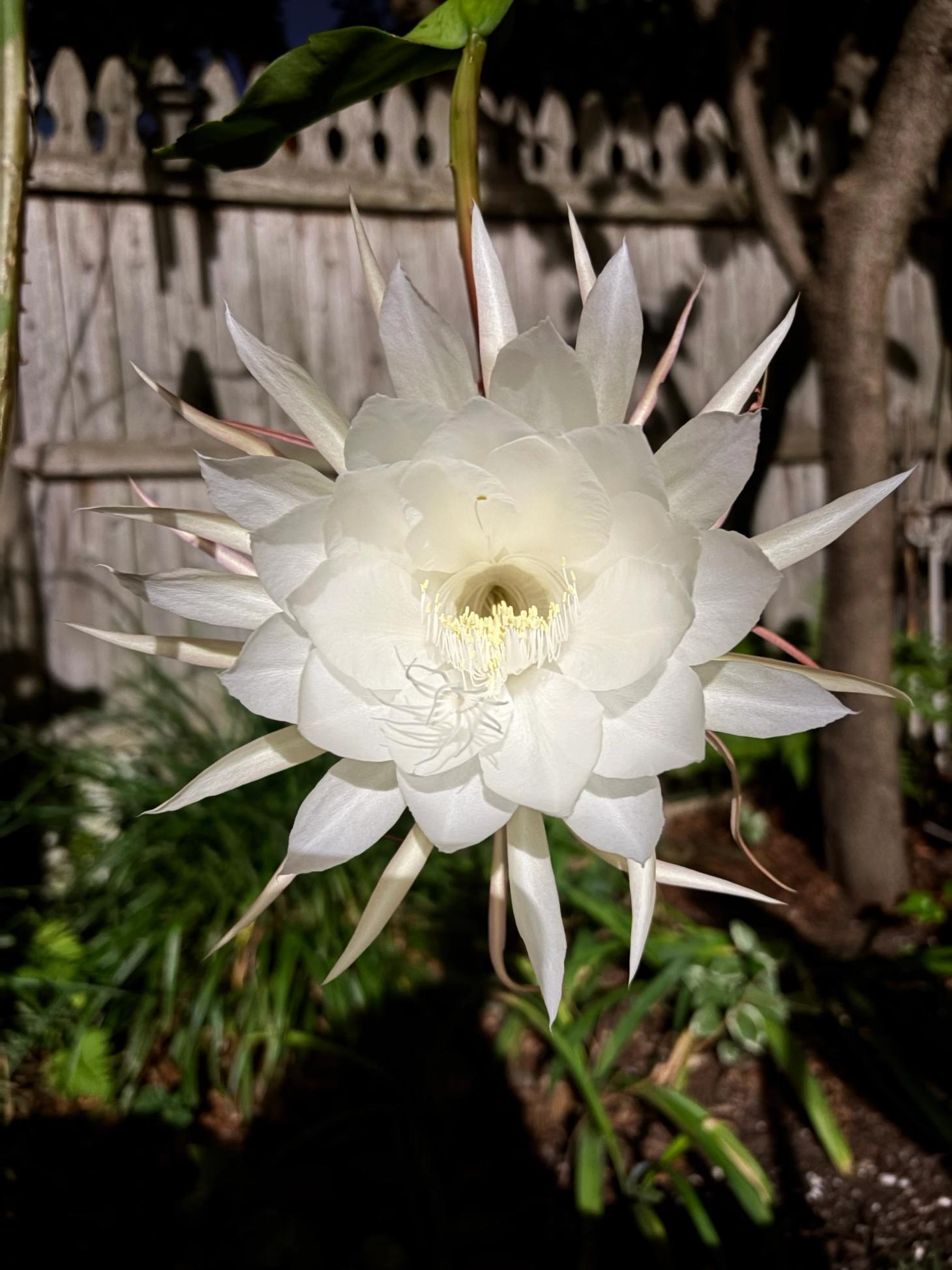
As a creative nonfictionist, I would rather be instructed by a flower or a snail. Recently, my night-blooming cereus bloomed. It was my mother’s plant, that I retrieved from her apartment following her death several years ago, and it is possible that this plant had not bloomed in twenty years. The way that it comes into being is marvelous and weird and beyond my comprehension. The bud emerges from the side of a leaf. It is no bigger than a bread crumb and just as indistinct. Eventually, this crumb develops into a kind of tube (like an umbilicus) at the end of which a bud appears. It can take up to two weeks to emerge into a full-fledged flower, whose intricacies are wondrous (see photo attached). It cranes toward the moon and opens ever more fully as it edges closer to midnight. It has a powerful scent to attract pollinators (some say in its native West Indies it is pollinated by bats). Through the night, it begins to close and fade and is dead by morning. As a writer, I consider it my sacred charge to observe and follow and “learn from”—even aesthetically—the other life forms that I share the planet with. This brings me to the snail. I read the other day (thanks to a board game I was playing with my young nieces and nephews) that snails can sleep for three full years. This is not something you or I can do; I’d like to understand that. This is what “interests” me.
If we were in a class together, I would ask you to lean your interests against the straw dog that is AI and watch it dissolve into the ether from which it hails and to which it points. Then I would suggest, in pursuit of a fuller exploration of your question, that we begin by defining terms AND plumbing their depths—starting with the word artificial and intelligence. If we took time to do this, we might have something more substantive to contribute to the (presumed) conversation on AI’s perils and pleasures.
For me the word to pause over is generative, a word that I understand to mean life-giving but when attached to “AI” means simply “productive.” If we think of how much we, as social media contributors, produce and consume daily on a mass scale, then we can understand how generative applies to AI. Production and consumption, to my mind, keeps us in place; it’s fundamentally static and at the same time scarily infinite in the energies it draws from us. Does it incite or inspire?—i.e., move us to act, provide us with the raw material of our senses, memories, and observations toward the adventure that is artistic discovery? Does it help us to breathe (i.e., inspire)?
Great writing and art are life-affirming and likely to offer the conditions of possibility for what Hannah Arendt calls “natality”: the capacity to begin again, from a different vantage; the prospect of a bringing-into-being a question, idea, feeling state, or relationship to language.
When was the last time you read or wrote something that felt “generative,” and how is this different from “productive”? These are the kinds of questions I would propose that we ask.
Recently a copyeditor for my new book wrote to tell me that reading it “made her feel alive.” This, to me, is one definition of generative. I don’t think there is much that is generative about AI. But I do think it aims to collect and produce great gobs of information that we are then asked to consume. I don’t think it aims to help people feel alive, or to understand the terms of their existence as sentient beings. I think it mostly wants to make us dependent on a mechanism that hopes to assert itself as indispensable to “living” but not to reflecting or creating, life reduced to something lifeless.
All of this said, I want to remember the great John Cage who would probably direct us differently in these matters. Because we don’t want simply to come off as technophobic. Nor do we want to expend our precious creative energies on the sort of reactionary responses AI no doubt anticipates, expects, and hopes to provoke. In Cage’s Day, a fellow artist complained to him that he was distracted by transistor radios on beaches and unable to create amid their noise. Cage suggested that he just needed to incorporate the radio into his art. Incorporate it and make it do things it’s not likely to know how to do. Misuse it. Recreate it.
Do you and I share a distaste for AI? An aversion to it? Or is it that we prefer to train our attention elsewhere? Again, I’m not proposing that we pretend it doesn’t exist. I just really don’t see how it can possibly “help us” or why we would feel compelled to turn to it in the making of our art. We have seen in the course of human history how perennial the problem of territorialism is. AI seems compelled by a desire to colonize our imaginations. A friend of mine, on reading these words to you, points out that AI is indeed “generative”: it generates profit for those that produce it. So maybe our creative acts, practices, drives, and habits are distinct from it in this as well: we don’t have anything to sell; we’ve only something to share. Relying on AI might just be another example of our willful participation in capitalist predation.
Last but not least, if you want to continue to pursue these questions, it probably couldn’t hurt to return to Walter Benjamin’s famous essay, “The Work of Art in the Age of Mechanical Reproduction.” As well, the Russian writer whom I quote in “Wending Artifice” and whose work I have always loved, Mikhail Epstein, has written extensively on AI. If you follow him on FB, you can see some of what he’s thinking about it. Or just run a search and you’ll find him engaged in many conversations on the subject. Unlike me, he seems deeply fascinated by the potential that it offers to writers.
Oh, but we’re not writers anymore. We’re “creatives.” UGH.
I’d better close there and I hope my response is helpful to you and your classmates.
All my best,
Mary
*
With thanks to Austin Gallagher for his genuine interest in my work, and for allowing me to recount our exchange publicly.
*
Author’s Note:
The links that I’ve supplied to “Our Share of Night to Bear” and “Soul, wilt thou toss again?,” point to the indispensable resource that is The Emily Dickinson Archive (EDA) and as they appear in The Poems of Emily Dickinson, Variorum Edition, Edited by R. W. Franklin, Cambridge, Mass.: Belknap Press of Harvard University Press, 1998, With thanks, always, to Marta Werner.
- 1.
The phisher’s second question read: “We will shed light on some of her neglected poems could you give us a summary of these two poems, ‘Our share of night to bear,’ and ‘Soul, wilt thou toss again’?”
My reply:
I’m intrigued by your interest in “shedding light on some of her neglected poems,” Matt, because some Dickinson scholars would say that her whole corpus has been neglected insofar as bringing their original versions into view and un-editing the garbling of editors through the ages has taken more than a century. We’d have to begin by learning the source of these versions you’ve put before me.
All summaries of Dickinson’s poems (or maybe of any poetry for that matter) read as parodies of the thing itself. That her poems can’t be summarized is one of the things that makes them great. In fact, they actively resist summation. Moreover, we could probably find a commentary in her poems on the subject of summation, measure, reduction, key and clue. I prefer to engage her poems by asking what questions or problems the poem animates. By tracing her use of words-as-things not just as referential pointers toward a solution of a riddle. By listening and watching for the movement and placement of her words on the page.
Here’s what I can offer as a summary of “Our share of night to bear,” which is part of my own “night” because I can barely bear to do this to a Dickinson poem: everyone has a little of both, night and morning, darkness and light, to bear, just as everyone can do what they will to fill or pass time. We try to be guided by the stars in the heavens as guideposts, but the evidence is flimsy, and before we know it, time has moved on anyway, with no concern for whether we’ve understood, found our way, recovered from our grief or fully known our bliss. That’s a possible summary, and, to my mind, the worst thing we can do as readers of Dickinson’s poetry for that matter—boil it down to a nearly neat parable made up of clichés. I’d rather comment on what the poem requires me to notice; on how it works rather than what it might “mean”; what questions or problems it animates or dramatizes by its arrangement. By cancelling the words that would appear if the opening lines were sentences rather than lines (i.e., “we all have our share of night to bear”), the poem emphasizes the word “our” (with its pun on “hour”) and with a visual hyper-exposition of the letter O (which is even more powerfully apparent when the poem is lineated flush left as it no doubt would have been in manuscript). The poem performs what it seeks to address: an apprehension of oh-ness, nothingness, the formation of something from nothing. How do we get from “share” to “blank”? They are of entirely different registers. What is the space between “morning/mourning” and “scorning”—between grief and anger? What is being barred from intelligibility in the space of that dash!? Those are the questions I’d say the poem is “about.”
As for “Soul, wilt thou toss again,” all that I will say at short notice (!) about this poem is that it’s an example of Dickinson at her heady and hilarious best. She reinvents the language. Makes and un-makes it. So, that opening startle when we realize that she’s not using toss together with soul in the usual way, i.e., a soul-tossed torment, the tossings of one’s soul, but in a very literal sense as in tossing of dice. Toss is such a funny word—or now, thanks to Dickinson, it starts to become funny, as in curious, interesting, new, and strange, and my next step if I’d have time, would be to look up the word’s etymology. What’s the difference between tossing the dice and throwing them? The surprise of the entirely cryptic and poetically irregular, “But tens have won an all” left me gasping. But my favorite lines, and ones that I think would make an incredibly interesting bumper sticker are: “Imps in eager caucus/Raffle for my soul.” We usually don’t find the adjective eager alongside the noun, caucus, and she seems to have invented a prepositional phrase: “in eager caucus,” so I did look up the word caucus and was delighted to discover that it hails directly from New England—Boston, to be exact—and that it may be a derivation of an Algonquin word “cau′-cau-as′u, which occurs in Capt. Smith’s Virginia 23, as Caw-cawaassough ‘one who advises, urges, encourages’, from a vb. meaning primarily ‘to talk to’, hence ‘to give counsel, advise, encourage’, and ‘to urge, promote, incite to action’” (according to the OED). Is it enough that the poem has taught me to hear this word anew? That’s just the beginning of a much longer journey, the curious unwinding of which we can’t predict when we read a Dickinson poem.
↩︎

Mary Cappello
Mary Cappello is a queer practitioner of the essay who experiments in prose, memoir, literary nonfiction, and performative criticism. Her seven books include a detour on awkwardness, a breast cancer anti-chronicle, a lyric biography, and the mood fantasia Life Breaks In (University of Chicago Press, 2016). Her most recent book, Lecture, a speculative manifesto on the lost arts of the lecture, the notebook, and the nap, inaugurated Transit Books’ Undelivered Lecture Series. Hew new book, Frost Will Come/essays from the bardo, on bearing sacred witness to her poet-mother’s last days, appears this October 2026, from the University of Wisconsin Press. A former Guggenheim and Berlin Prize Fellow, she is professor emerita of English and creative writing at the University of Rhode Island. More at marycappello.com. (updated 10/2026)