
Lia Purpura, Decaying Wood (detail), featured in AGNI 102
To plan a route to pick up my child from school, I check iceout.org for a map of recent ICE sightings. They’ve multiplied in recent days, with the Federal occupation surging to 3,000 agents in Minneapolis, five times the size of the city’s police department. Earlier in the morning, an unconfirmed convoy was sighted near the Spanish-language immersion daycare two blocks from my home, and another patrolled four blocks west, near a restaurant where my choka works the dinner shift. I fold a copy of my naturalization certificate and zip up my coat pocket. My cell phone is charged. My gas tank’s almost empty, but I can make it if I fill up at the station on Lyndale, where there hasn’t yet been a sighting—at least not today.
Not every day is like this one. Some feel so humdrum, as I putz around my apartment, that I question my vigilance. Others are pierced by whistles and sirens. I no longer look outside or answer the door. (My landlord kindly taped up private property signs, downloadable at the City of Minneapolis website.) Then on January 24th, as I was on the phone with AGNI editor Bill Pierce, the drone of helicopters interrupted us, and text messages pinged: Are you ok? Where are you? Ice killed again.
The works gathered here constitute acts of witness from Minneapolis, 2026. They pull apart and lay bare the historical and embodied dimensions of carceral Trumpism by making sense of its full-scale assault on personhood and daily life. As Lau Malaver writes, “The border, then, is not outside us. It moves through us.” Fascism first attacks our senses, then moves through our imaginations, in its bid to normalize causeless maps of search and seizure. Our government is detaining and disappearing our neighbors. May these writers remind us all of our individual power to refuse this death-dealing cartography and to imagine one another whole and free.
Jaden Janak
Live from Occupied Minneapolis
January 28, 2026
The Federal government has occupied Minneapolis and the greater Twin Cities area for the past fifty-six days and counting. Operation Metro Surge, the Federal takeover of Minnesota, has resulted in thousands of arrests and detainments, and the mass brutalization of neighbors. Earlier this month, an ICE agent murdered Renee Nicole Good in broad daylight, just a few blocks from George Floyd Square—the location of George Floyd’s murder and the subsequent autonomous zone created for mutual aid, organizing, and communal resistance. A week later, a Federal officer shot and wounded Julio Cesar Sosa-Celis, an immigrant from Venezuela. Last weekend, agents brutally beat and subsequently murdered Alex Pretti in my neighborhood. The indiscriminate deployment of chemical warfare against observers by Federal, state, and local law enforcement and the wanton disregard of the illusory U.S. legal framework has left many feeling justifiably terrified.
In the midst of this horror, community members have mobilized much like they did after the murders of Amir Locke, George Floyd, Philando Castile, and Jamar Clark (to name a few). Some are delivering meals to neighbors who are afraid to leave their houses; others, like Powwow Grounds and Smitten Kitten, are hosting donation drives at their businesses. There is a robust and coordinated response across neighborhoods to meet the needs of those most in danger. As the Federal government sends in reinforcements, Minneapolitans keep showing up en masse to refuse the siege and affirm our collective right to life and safety.
Those who do not live here keep asking why mass resistance and liberation movements begin in Minneapolis. They wonder what it is about this space and place that lays bare the central contradictions of our country and elicits such widespread response from the people. Many know Minneapolis as the site where the American Indian Movement began in 1968. Others might know Minneapolis as the place where CeCe McDonald, a Black trans college student, was attacked by a white supremacist group and ultimately prosecuted for defending herself. A few may know that George Floyd’s murder illuminated the Minnesota Paradox—that despite its reputation for progressivism, Minnesota is home to some of the worst disparities for Black people in the U.S. But to really understand Minneapolis and Minnesota, we need to adopt a much wider historical lens.
The occupation of Mni Sota Makoce did not begin with ICE or the Border Patrol but rather with the infiltration of French fur traders in the mid-1600s. The French brought disease and knew little about the area, so they relied heavily on Dakota and Ojibwe epistemologies to survive. In 1680, Louis Hennepin, a Franciscan friar, came to Mni Sota Makoce to evangelize the indigenous populations and “locate” the Mississippi River. He founded a Catholic mission and was swiftly captured by the Dakota. While being held, Hennepin saw and named the only natural falls on the Mississippi River. Already known as Owámniyomni (Dakota) or Kakabika (Ojibwe), the falls became the St. Anthony Falls, somewhat ironically named for the Franciscan saint of lost items. For the Dakota, Owamniyomni is sacred land. It is connected to Bdote—the meeting place of the Minnesota and Mississippi Rivers and the center of one of the Dakota creation stories. French settlers remained the majority of the settler population until the mid-1700s, when the British took over the fur-trading posts and began expanding their colonial footprint.
In the early 1800s, white settlers sought to establish a military fort and trading post at Bdote.Lieutenant Zebulon Pike negotiated a treaty with the Dakota people to build what would become Historic Fort Snelling. Pike paid the Dakota only ten percent of the land’s value. The U.S. president did not approve Lieutenant Pike’s land expedition and, thus, Pike did not have legal standing to represent the government’s interests. But then as now, the illegality of Federal agents’ actions did not faze the state actors. After a few years of construction, Fort Snelling opened in 1825. Throughout its first decade, military personnel and fur traders relied extensively on the labor of enslaved Africans. The practice of enslavement was illegal in the land that would become Minnesota, but slavery continued nonetheless. Dozens of enslaved people lived, loved, and labored at Fort Snelling, including Harriet Robison and Dred Scott. They met and were eventually married there. Inspired by a successful freedom case filed in Missouri—the plaintiff was Rachel, an enslaved woman held captive at Fort Snelling—the Scotts sued for their own freedom. As we know, their 1857 case (Scott v. Sanford)went to the Supreme Court, which ultimately found that Black people were not people at all and therefore had none of the rights afforded to citizens. The next year, Minnesota became a state. After the Dakota Uprising of 1862, Fort Snelling was the site of the mass execution of Dakota freedom fighters and then became an internment camp used to imprison Dakota women, children, and elderly people.
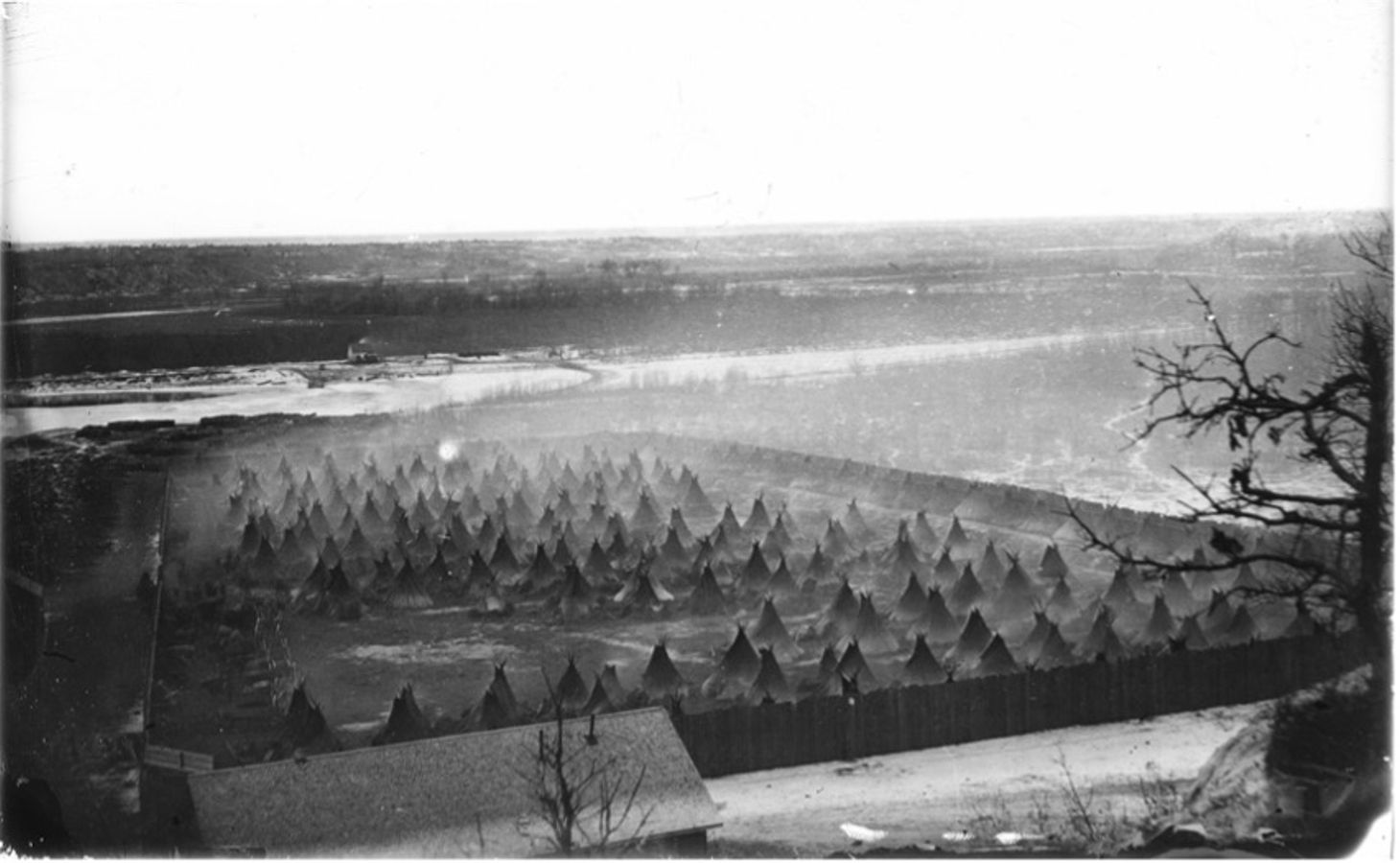
These horrific tales of colonization, forced migration, enslavement, and state violence are not an aberration. The truth is that this land has been occupied for hundreds of years. First it was the French, then the British, and after them, Swedish and Lutheran Norwegian settlers who opened colleges. The land of Mni Sota Makoce has also been occupied by carceral institutions and their authorities. In 1853, more than a decade before Minnesota became a state, the territory opened its first prison (now Minnesota Correctional Facility–Stillwater). Minneapolis itself has been occupied by the Minneapolis Police since 1867. It would be a critical error to assume that the violence we are facing right now is exceptional or ahistorical. The anti-Black and anti-indigenous violence of this country and this state is intimately woven into the fabric of this moment. The occupying force has changed. Its members increasingly representative of a rainbow coalition of imperialism. But the logics undergirding the invasion and occupation are the same now as always. For example, Historic Fort Snelling is part of the unincorporated territory of Fort Snelling, the larger swath of land that now houses the Bishop Henry Whipple Building, where ICE has been terrorizing protesters and locking up our neighbors, including Indigenous ones. The goal of these regimes remains land and resource acquisition through a campaign of terror aimed at eliminating undesirable populations.
This moment again makes clear that our foundational institutions cannot save us from settler colonialism. The country’s legal apparatus is part of that project, not the solution to it. ICE—closer to slave catchers than gestapo agents—do not care if one has the “proper” documentation from the imperial core. The State of Minnesota does not care that ICE is not “allowed” to bust in people’s homes, cars, and workplaces without a warrant. Invoking one’s Constitutional rights does not stop bullets to the head. Many of us have been manipulated into believing that voting for “progressive” politicians will ensure our safety, or at least make our lives a little more livable. But as we see so clearly now, our government officials have nothing to offer us beyond thoughts and prayers, with the occasional admonishment to remain peaceful as tear gas fills our lungs.
As a scholar of Black social movements and policing, I am reminded that we desperately need more community-driven interventions that expressly respond to the interlocking nature of interpersonal, communal, state, and colonial violence. Some have suggested that eradicating ICE might bring an end to the wanton violence of immigration enforcement. The elimination of ICE, an agency less than thirty years old, would bring momentary relief for some. But if we understand ICE, the imposition of borders, and policing as part of a wider strategy for mass elimination, then merely shutting down the agency will not bring an end to the violence it begets.
My research and organizing work focus on prison abolition—a school of thought and practice aimed at dismantling the widespread network of systemic violence (often referred to as the prison industrial complex) that produces differential life chances for different groups of people, and developing a collective capacity to imagine and build a world beyond policing. After the murder of George Floyd in 2020, Minneapolis organizers pushed for the abolition of the Minneapolis Police Department. They gained initial support from the city council and placed the words “defund” on the tongues of people around the world. That summer, the Movement for Black Lives released a federal proposal for abolition in 2020 known as the BREATHE Act, which sought to implement abolitionist principles on a national scale. As we know, the proposal to defund the Minneapolis Police Department was eventually defeated. More money goes to policing in Minneapolis now than it did in 2020. The BREATHE Act did not make it past the point of being introduced. If it had been ratified, ICE would not exist and neither would federal prisons. The defense budget would be slashed and in its wake, healthcare and a social welfare net provided. If the Minneapolis Police Department had been defunded, we would have better funded infrastructure to support unhoused people, education, and collective flourishing. Though these interventions were defeated, they did not fail. They opened a new paradigm for reconsidering the permanence of policing and prisons. These interventions show us that abolition should be the floor, not the ceiling, of our imaginations for a better world. To overcome social problems, we need more bold, brave communal solutions that do not involve law enforcement or policing of other kinds. This is life or death work.
Over the past several weeks, I have seen glimpses of what safe communities can look like. Tens of thousands have packed the streets to express their righteous discontent. After the murder of Good, I attended a protest in Powerhorn Park, near the site of her murder. There, I saw signs connecting the dubious history of U.S. policing with the genocide in Palestine and the U.S. takeover of Venezuela. I heard sirens drowned out by the dulcet ring of jingle dresses. I witnessed neighbors who know American Sign Language walking through the crowd and interpreting for those who are deaf or hard of hearing. Even as conditions seem to be increasingly getting worse, I’ve watched proudly as my neighbors, armed with whistles, bright vests, and gumption, face off against heavily armed militia—and win! There have been multiple calls for work stoppages, the most recent of which, on January 23rd, led thousands to go on strike and hundreds of businesses to close. In this time of great fear and aggression, we’re seeing the truest definition of comradeship play out across the metro area. Every skillset is necessary in this moment. The trans anarchist hackers are just as important as the indigenous elder leading the dance.
I don’t know how long this siege will last. I pray it ends soon. But when it’s over, the occupying army will move to a new location and start again. To have any chance of surviving this moment and the ones to follow, we need one another. This is a time for community, not isolation. Any modicum of safety we might have, we have because of communal resistance. We owe it to one another to overcome this occupation by first attending to the long history of occupational violence that precedes it.
A luta continua.
Lau Malaver
Recovecos under Siege
January 28, 2026
Handwritten and printed signs are strung from my neighbors’ balconies, taped to their windows, propped against radiators. “ICE Out!” “Fuck ICE!” “ICE Is Not Welcome Here!” It feels hard to get up from bed these days. My routine begins with a few seconds of gratitude, followed almost immediately by a jolt. My body tightens. My chest constricts. My throat interrupts speech before it forms. I wonder what happened while I slept, and what is newly in motion.
I reach for my phone. I scroll: group chats, social media, emergency threads. More abductions. Another protester shot. Many injured. Some denied care. Everyone under siege. I sit comfortable but alert in my living room. On my reading chair there’s a sign like the ones outside: “I.C.E. Out of Minneapolis.” This is the present tense of my block, my neighborhood, my city.
I come to this moment through what I call recovecos: the nooks, twists, folds, and recesses of lived experience that open in the cracks of empire. Recovecos are not only physical spaces but epistemic and affective turns: the hidden curvatures of survival where the modern surveillance machine loses its line of sight. They are alleyways and living rooms; church basements and back hallways; bodies curled on couches unable, yet, to rise. They are the intimate corridors where life is sustained under siege.
When you’re a person othered as a “minority” (in my case Latino) and you’re living within American empire, “Migra!” is not simply a warning cry. It is a theory of the nation condensed into a word. As Kelly Lytle Hernández writes in Migra! A History of the U.S. Border Patrol, migra names a mobile institution of racial governance: one that reveals the border not as a static line, but as a method that moves wherever agents patrol, question, and detain. The border appears inland, in neighborhoods like mine, because the target is not a geography of stolen land, but a population continually rendered deportable. The cry “Migra!” trains the senses. It emphasizes the truth of racialization: some bodies belong without question; others must prove belonging on demand. Border Patrol, founded in 1924, and Immigration and Customs Enforcement (ICE), established in 2003, are professionalized policing apparatuses that legitimate themselves through racialized administration, using tactics that I have seen with my own eyes for the past two weeks in Minneapolis and for the past decades on a screen: stops, raids, ID checks, detentions, deportations. The violence looks procedural. It is destructive and hurtful—spectacularly so—in proportion to its ordinariness for la migra.
The border, then, is not outside us. It moves through us.
I am back in my living room, tracing the invisible lines that tether us rather than divide. Minneapolis is not a border city, yet Minnesota has long been treated as an inland site where enforcement becomes exemplary and disciplining. The 2006 Worthington raid remains a landmark: nearly 239 workers were detained, leaving the city’s 11,283 residents in complete turmoil. Churches began mobilizing overnight to provide sanctuary, contending with how daily life, jolted, began to reorganize around the threat of removal. The knock at the door becomes a question of survival. “Migra!”
Today, in January 2026, the Twin Cities once again sit at the center of intensifying enforcement and retaliation. ICE vigilantes circulate through our neighborhoods in SUVs and other random vehicles, sometimes not wearing uniforms or tactical gear. Federal pressure campaigns under the Trump administration (though first used during Obama’s administration) frame sanctuary as an obstruction, almost an impediment to their “mobile institution of racial governance.” And some of us are indeed impeding that structure, because we are under siege, and because we are inside recovecos of relation that refuse disappearance and containment.
Recovecos are not quiet spaces. They hum. They vibrate with the residue of history and the pulse of the not-yet-here, that future we’re creating, imagining, and moving toward in the now. To inhabit a recoveco is to dwell in what Gloria Anzaldúa calls nepantla: the in-between space where contradiction and transformation coexist. Fred Moten has similarly called this condition fugitivity: “the consent not to be a single being.” Recovecos as physical and psychic spaces invite that multiplicity, where I can feel the confusion of pain and hurt in community, while alertness is held and other organizing takes shape. These spaces and places refuse empire’s demand for coherence, for some of us to be legible to them as deportable, capturable, ultimately fugitives. Recovecos commit to motion without arrival, inviting us to traverse these times among friends, loved ones, neighbors, and allies. This is why Recovecos is a theory in motion.
In this moment’s sonic terrain of Minneapolis—and Minnesota at large—recovecos become acoustic refuges. Sound travels where bodies cannot. In the layering of chants—“Say her name!” with regards to Renee Good, “Say his name!” with regard to Alex Pretti, the white man and woman murdered by ICE vigilantes—in the sounds spiking from our observers’ whistles, and in the quiet coordination of neighbors, vibration against this demand to cohere into a single deplorable, deportable mass becomes a politicized, radicalized infrastructure. Empire depends on rhythm control, including labor time, debt time, carceral time—a metronome of extraction. Against this, Recovecos allow for syncopation, for off-beat coordination, for lives lived out of the mass, imposed tempo. I feel this palpably. During video calls with my mother, my friends across the world, and my community in Minneapolis, we hum together in our despair and hope, in the nepantla that is demanded of us. This is again when I think about jolts.
A jolt is an interruption in the expected flow of time and movement. It is the shock that reveals how space and time are governed. The tightening chest. The sirens and helicopters outside. The sudden recognition of a shared fear. Jolts are not clean ruptures; they recalibrate us toward a different reality, even if an imagined one. They force bodies to adjust their orientation in order to live in the midst of fear. They expose the fantasy of smooth circulation that an ever-colonizing capitalism depends on. Often, the jolt deposits us back into a recoveco: the room that quivers with shared recognition. I am jolted every time I wake up from sleep, and quiver toward the acoustics of my breath and the notifications coming from my phone. We are jolted at this moment by a concentration of state-sanctioned violence. And here, we also jolt back, defiant and strong.
I am on the couch again. This time my partner and I are organizing: household plans, neighborhood check-ins, ways of supporting the larger fights against fascism. Elsewhere, a friend and I wrote:
Fascism thrives on synchronization: the spectacle of sameness, the demand for unison.
Solidarity moves otherwise.
It lives in dissonance, in syncopation, in the off-beat coordination of bodies that refuse to march. Solidarity is not harmony.
It is the capacity to pulse together without becoming the same.
A practice of co-resonance. A vibration of difference.
Earlier in the day, my partner went to our neighborhood coffee shop, Modern Times. People gathered there quietly—but loud in their demeanor—urgently passing out posters for windows, balconies, and the next rally. She brought one home, and found me in the same position as when she’d left. It still feels hard to get up. But even here, in this recoveco, in this fold of fear where I breathe, energy circulates. If empire extracts energy, resistance redistributes it. To dwell in a recoveco is to reroute attention and affect, to refuse acceleration, to reclaim time from extraction. People messaging on group chats, asking for rides, meals, daycare. This is an alternative political economy—an economy of the pulse, of our current reality under occupation in Minneapolis.
Care, attention, and energy become currencies that empire seeks to capture and coopt. Recovecos and jolts teach us how to channel them otherwise. We must pulse together to reimagine economy as relation, not exchange. Ours is a politics of listening, of sensing, of vibrating with others across difference. Our work is not only to critique empire’s soundscape, but to compose a different one. This is not merely survival. It is the rhythm of living otherwise.
Kathryn Nuernberger
Does It Fuck You Up?: Notes from an Occupation
February 9, 2026
I was telling my friend about my current work-in-progress. My friend is not a citizen, she has a green card that will need to be renewed soon. When you live in Minneapolis-St. Paul many of your friends are not citizens. And many of your friends are naturalized citizens. And many more are the children of naturalized citizens or people who are not citizens. If you’re a teacher, your classrooms would have once been full of such students; now your classrooms are full of empty desks and you search your Zoom screen for their names in black boxes, hoping that they’re alright.
I was telling my friend about my work-in-progress because she asked. Because I’d just asked her the same question. Because we were trying to change the subject after an hour discussing what we fear, who we check on, what risks we take, what risks we are ashamed of not taking.
For the past few years, I was telling my friend, every time I see something beautiful, I google it with the words “and weapon” or “and DARPA” or “and Department of Defense.” Because white phosphorous was once thought to be the philosopher’s stone. Because the chemical weapon lewisite smells like geraniums. Because engineers model drones after dragonflies and drone swarms after bat colonies flashing across the night. Because goldenrod and dandelions might be a better source for the rubber that seals the cockpit of a fighter jet. Because there were long years when the State Department kept telling diplomats who had been knocked to their knees by the force of a mysterious blast of sound that it was just very loud crickets. Because I love crickets. Because the Vice President of Research and Innovation at the university where I work told me it was the balletic drifting of jellyfish that inspired his early work as an engineer designing what he referred to vaguely as “Department of Defense stuff.”
Because I think moths are so beautiful. Especially the little yellow ones that flutter over the fields of yarrow and cornflowers in spring. Especially the Isabella tiger moths, that start as the fuzzy little wooly boogers I would let crawl up and down my hands when I was a child. Thre’s a program called Insect Allies, I told my friend. It’s funded by DARPA and one thing scientists are trying to figure out is exactly when and how during metamorphosis they can inject a sensor—a camera or a listening device—into the goo of becoming that’s inside a cocoon, so that the moth will emerge more fully integrated with their hardware. A new creature easier for them to steer.
Does researching all this fuck you up? my friend wanted to know. I think the answer is no. I think the answer is I’m alright.
But there is this: Last night I went out to walk the dog. We spend much of the winter here in Minnesota blanketed by thick clouds. And in the city, even when the clouds thin, the haze of lights blocks out all but the brightest of stars. I’m the one who puts the toddlers to bed in our house, so I don’t see much of the night these days. I lay in the dark, looking at the news on my phone with one hand, holding a tiny finger with the other.
But last night I was out and a sharp cold front had pushed the clouds aside for a while. The stars were shimmering and there were so many more than I could remember ever seeing in the city before. They were nearer than I remembered, and farther. And they were moving. Like airplanes, but there were too many for airplanes and they weren’t moving fast enough. They were so bright, there were so many, and it seemed they were moving together. As if in formation. I couldn’t understand it. I thought maybe it was a drone swarm over my neighborhood. Then I was sure it was a drone storm. And also I was certain it couldn’t be. It definitely wasn’t. I didn’t believe my eyes and I didn’t believe my mind either. By the time I got home and called my husband out to look, the clouds were gathering again and the stars were dim as usual.
Before I left the house, I had been laying in the dark looking at videos of an ICE agent shooting Renee Nicole Good in the head. I had been looking at messages from neighbors following ICE agents all over the city. They flash up my phone: Plate check. Plate check. Plate check. Agents out of their vehicles at this intersection, agents out of their vehicles at that intersection, updates about who is logging off now, who is joining the group, who is watching the elementary school today, who is watching the mosque. That afternoon, between my house and the park, I stared into the eyes of a masked man in camouflage with his hand on a gun, one of at least twelve men in uniforms surrounding a neighbor’s house. I stared into this man’s eyes and blew my little whistle, faintly, irregularly, like someone afraid I didn’t have the right. I thought about how much he looked like young men I’ve known in my classrooms over the years, the ones who want to be something they call brave, the ones who want the world to be simpler, the ones who are afraid they aren’t enough. I thought about how easy it would be for him to shoot me in the face. I was shaking then. I shake even now when I think about it.
They might have been drones. They were probably stars. I might be a little fucked up, but I think I’m alright. Other people have so much more to fear and so much more loss to carry.

agnimag
By the AGNI staff.