
Lia Purpura, Decaying Wood (detail), featured in AGNI 102
You Are Not the Choir—or, Seeing the Matrix
A couple of years ago I co-organized an AWP (Association for Writers and Writing Programs) Conference panel to discuss the bridges between literature and climate justice. During the Q&A portion of the panel, someone in the audience asked a valid question about whether writing literature addressing climate change was “preaching to the choir.” The inference was that those of us writing and reading literature are already aware of and concerned about planetary warming, and therefore reaching this already informed, sensitive, and largely politically progressive audience doesn’t do much to further environmental causes. I’m grateful that one of the other panelists, the poet Roger Reeves, volunteered to respond to the question with an answer whose wisdom and clarity have stayed with me since.
“We are not preaching to the choir,” Reeves said, “because we are not the choir.” He went on to explain that even those of us who consider ourselves to be enlightened on issues like climate change and social justice still have work to do and often have more to learn than we think. He also noted that the purpose of creative writing is not (or not only) to inform or change the reader. Rather, if we’re doing it right, the process of writing changes us.
Some of us have done more inner work than others. Some of us—because of life circumstances, or racial, gender, economic, or other positionalities—have had to develop keen awareness and insights about systems of harm while others of us have not. That is a fact of the world we live in, and whoever you are, wherever you’re starting from, we all have things to teach and room to grow. But just as we must become lost in the woods before finding the golden key, so it is that your willingness to be bewildered and open yourself to what you don’t understand, even to question what you already know, is a prerequisite to transformation. In other words, don’t expect to change the minds of readers if you can’t change your own.
One of the ways that we transform through writing is not so much an about-face on a particular issue, but an experience of deepening or complexifying understanding, or what I call seeing the matrix. In these cases, the writing process reveals the larger systems underlying an issue that initially appears more personal, straightforward, or discrete. Thoreau’s Walden, for example, begins as an ode to simple living and the joys of solitude, but by the end of the book turns into a nuanced critique of industrial society and materialism. Alice Walker’s The Color Purple, too, shifts in at least a couple of ways over the course of the book. While Walker’s perspective becomes increasingly intersectional, widening its view to the overlapping systems of race, gender, class, sexuality, and colonial structures within and beyond the United States, she also raises the possibility for redemption and non-patriarchal forms of spirituality. Similar revelations of the matrix can be seen in feminist science fiction writer Ursula K. Le Guin’s explorations of gender. After her efforts to create a society of sexually nonbinary people in The Left Hand of Darkness came up against the patriarchal structures hiding within grammar and storytelling conventions, she found ways to subvert these conventions in her later novel, Always Coming Home.
We can all think of examples of this phenomenon in the books we love, as well as in our own experiences. Unlike the high school English or freshman composition classes that required us to state our thesis or argument before we even completed our research or discovered our questions, wilderment requires us not to claim answers before the questions have been asked and journeyed with over a distance. As Joan Didion commented about her own process, “I write entirely to find out what I’m thinking, what I’m looking at, what I see and what it means. What I want and what I fear. Why did the oil refineries around Carquinez Strait seem sinister to me in the summer of 1956? Why have the night lights in the Bevatron burned in my mind for twenty years? What is going on in these pictures in my mind?”
Why indeed? It is the willingness to follow the things that bewilder us, the odd hunch—whether it leads toward a well-worn subject or one about which you know nothing—and to do so with an open heart and mind, that can lead you toward the matrix, the web of connections underlying all things. You may not be able to explain why you’re drawn to a certain topic or image, or a certain word or phrase, even when the pull is strong. Or at least your explanation will feel inadequate next to the power of the pull the subject has on you. I think of all my books as processes of bewilderment and change: each begins with an image or question that, as Didion says, “shimmers around the edges,” and then draws me toward deeper, stranger understandings of the world and my entanglement with it. When you feel this pull, try to trust and follow it without becoming attached to a particular meaning or outcome. This practice alone is a powerful way of practicing negative capability and opening yourself to change.
The shimmering image that began author Elizabeth Kolbert on the journey that became her Pulitzer Prize-winning The Sixth Extinction: An Unnatural History was of a beautiful, critically endangered creature: the Panamanian golden frog. Before I say more about this book, however, I must confess that for a long time, I was afraid to read it. Knowing that my work was increasingly focused on climate change and other ecological concerns, a close friend of mine had gifted me The Sixth Extinction along with a bar of chocolate and some tea to calm me as I read the upsetting material about extinction. I ate the chocolate and drank the tea, but for months I couldn’t bring myself to pick up the book, which I was worried would increase my climate anxiety. While I have friends who choose, or are required by their work, to constantly digest climate data and other news, I try to moderate my intake of that information and, when possible, to meet it only when I have the fortitude to take it in without being thrown into a tailspin. When I’m overwhelmed, I find myself much less capable of supporting the beings and causes that matter to me.
I read the book when I was ready, and am glad I did, as it is an expertly researched and narratively compelling journey through the past and present extinctions on Earth. As a longtime environmental commentator for The New Yorker, Kolbert began her research and writing journey for The Sixth Extinction with substantial topical knowledge about climate change and its connection to human activity. Thus, the transformation that Kolbert undergoes in her process of writing doesn’t lie in the fact that human beings have had a significant—and disruptive—impact on the planet, but in her discovering the extent to which human involvement in extinction goes beyond climate change and even predates modernity and the industrial revolution. Between deforestation, the damming and diverting of rivers, overfishing, and the introduction of invasive species—coupled with releasing enormous quantities of CO2 into the atmosphere—Kolbert comes to understand humanity itself as a geological force. She posits that perhaps humanity’s will to shape and explore our surroundings, to create and innovate, can be understood as a “madness gene,” distinguishing us from our less ambitious Neanderthal and great ape cousins.
Thus Kolbert—like many of us—comes to grapple with the great contradiction apparent in human nature itself: If we were simply uncaring and short-sighted, so many people of all stripes—from scientists to activists to conservationists—would not be working so hard to save and protect vulnerable species. At the same time, knowing the risks and costs of our activities hasn’t done nearly enough to change our collective course toward destruction. While we can mitigate and slow the causes of extinction, more or better information is not enough, she realizes, to eliminate the “madness” of our makeup. So, while she begins the book with somewhat neutral, journalistic curiosity, she ends on a more sober, elegiac note, asking whether extinction itself will be humanity’s legacy.
Kolbert is not all doom and gloom. Along with the many species we’ve lost and continue to lose, she takes care to note some great success stories in conservation, like the Bald Eagle and the California Condor. I wonder, though, how it might have shifted her outlook to consider human societies, past and present, that have successfully lived in balance with lands and ecosystems, like many of the indigenous peoples around the world—from the Americas to Australia to Africa to Northern Europe—and societies like the Bishnoi in India and many contemporary permaculture communities. These things, too, are part of the matrix, and prove that other, less “mad” ways of being are possible.
In some cases, whether brought about by a writing project itself or by other life or political circumstances, a writer undergoes an even more significant change in perspective, one that not only deepens and complexifies their understanding but also fundamentally troubles or transforms their views. In addition to following the bewildering, shimmering subjects where they lead on the page, these radical shifts of perspective often involve a literal journey, an embodied experience that challenges what the author thought they knew. In other words, these writers—from James Baldwin to Maggie Nelson, George Orwell to Adrienne Rich—put themselves in the way of transformation.
Ta-Nehisi Coates has always embraced bewilderment in his work, and his willingness to be vulnerable, to ask questions, and to revise earlier viewpoints is an excellent model for those of us who would open ourselves to transformation. The fourth section of his book The Message, in which he writes about his travels to Israel and the occupied West Bank, offers a striking example of this. Witnessing first-hand this two-tiered society—from separate protocols at checkpoints to roads marked for different license plate colors to municipal water access—Coates likens it to new a version of the Jim Crow South where even one’s permission to collect the rainwater falling from the heavens is determined by one’s ethnicity.
Coates’s reaction to what he sees is significant because—like many of us who have understood the conflict between Israel and Palestine through the lens of U.S. politics and media—he hadn’t understood the system there as analogous to South African apartheid or to the racist laws in his own country that his parents and other ancestors had lived with, the systems of oppression that he had deeply studied and explored in his own writings. Walking the land now and feeling the violent histories overlapping with the violences of the present, he writes:
But there was a time when I took my survey from afar, and invoked this same land to service my own, more narrow story. It hurts to tell you this. It hurts to know that in my own writing I have done to people that which, in this writing, I have inveighed against—that I have reduced people, diminished people, erased people. I want to tell you that I was wrong. I want to tell you that your oppression will not save you, that being a victim will not enlighten you, that it can just as easily deceive you. I learned that here.
This passage reveals a powerful insight beyond its admission of fault: that people from oppressed groups are not immune to oppressing others, that past victimization can lead to the perpetuation of pain rather than to empathy.
The past writing that Coates is referring to is his 2014 essay “The Case for Reparations,” where he uses payments to the state of Israel by Germany after World War II as a potential model for restorative justice. Coates admits to what he now perceives as a mistake and explores the limitations of his past perspective with new eyes, explaining:
I always imagined reparations as a rejection of plunder at large. And who in modern memory had been plundered more than the victims of the Holocaust? But my prototype was not reparations from a genocidal empire to its Jewish victims, but from that empire to a Jewish state. And what my young eyes now saw of that state was a world where separate and unequal was alive and well, where rule by the ballot for some and the bullet for others was policy. I was seeking a world beyond plunder—but my proof of concept was just more plunder.
To me, this section in which Coates lets himself be changed by his visit to Israel and Palestine while being brave enough to admit to past mistakes is the most moving part of The Message. Even someone like Coates who has written thoughtfully and passionately about race and histories of oppression—from the National Book Award-winning Between the World and Me to his gorgeous novel The Water Dancer—is not, as Roger pointed out at our conference panel, “the choir.” What makes Coates a great writer is not his perfectly informed or enlightened views on social justice, art, or history, but the ways his deep curiosity, his moral sense, and his willingness to stay with difficult, troubling topics combine into his own flavor of negative capability.
Excerpted from Wilderment: Creative Writing in the Time of Climate Change (West Virginia University Press, forthcoming 2027)
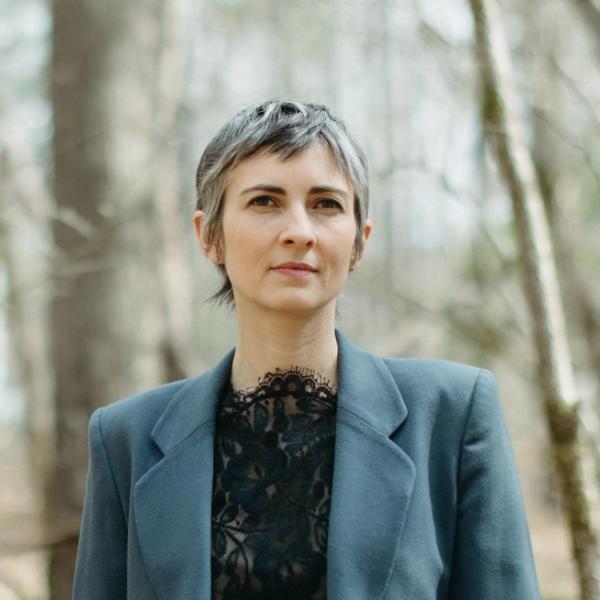
Sarah Rose Nordgren
Sarah Rose Nordgren is the author of Feathers: A Bird Hat Wearer’s Journal (Essay Press, 2024), which won the Essay Press Book Prize; the poetry collections Darwin’s Mother (University of Pittsburgh Press, 2017) and Best Bones (Pittsburgh, 2014), winner of the Agnes Lynch Starrett Poetry Prize; and the chapbook The Creation Museum (Small Harbor Publishing, 2022). She serves as Emerging Poet Feature editor for 32 Poems and is founding director of The School for Living Futures, an experimental project dedicated to shifting culture in a time of climate change. (updated 4/2025)