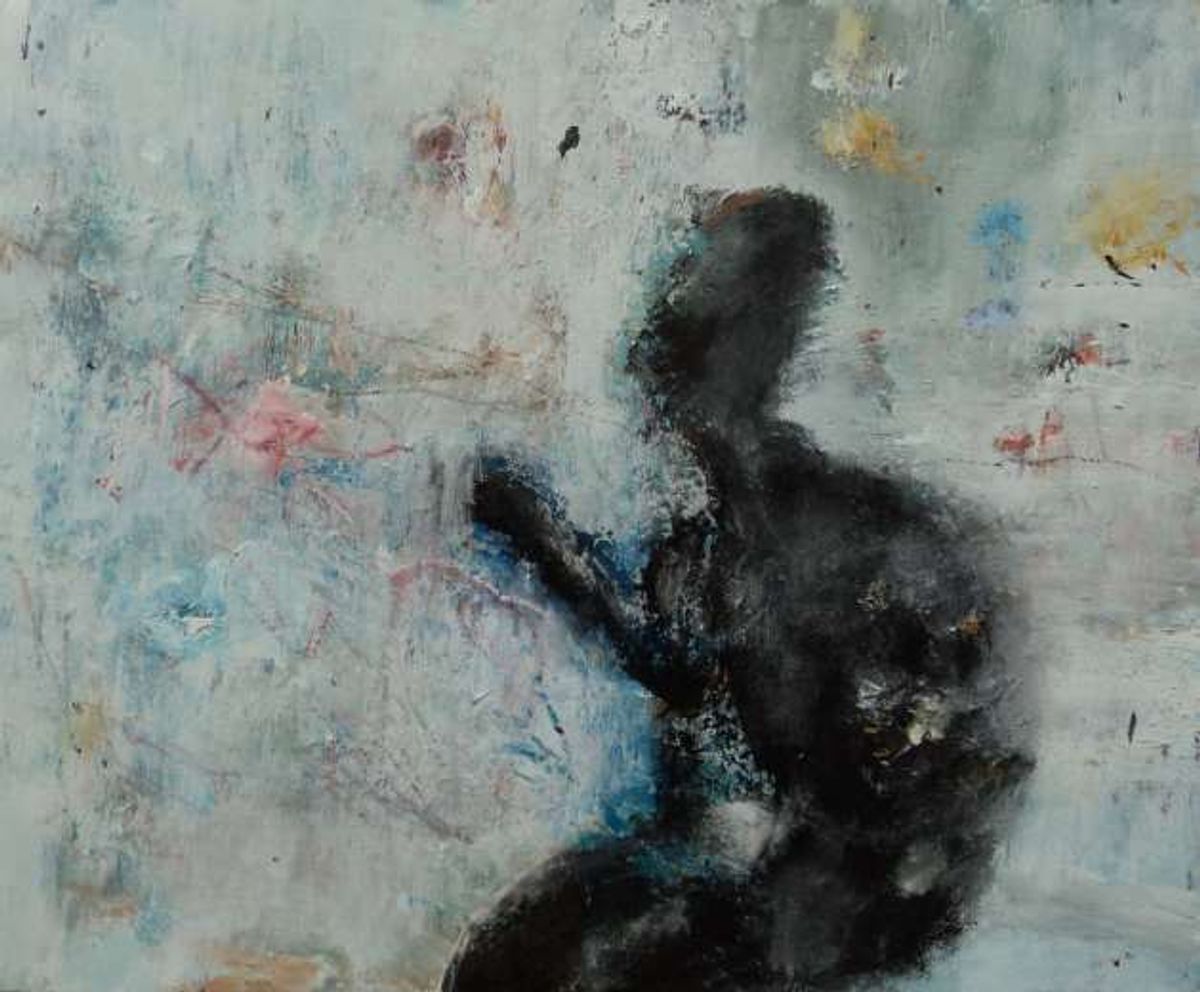
Guillermo Arreola, Sursum Corda (detail), 2015, acrylic on X-ray. Used with permission. Please see full image below the poem.
Sea Lung
Your finest hour.
When you were no longer you.
An ideal dissolution, so to speak.
A mere unknown, forging forward
between sheer blue and abyss,
between sky blue and total melancholy,
between exultant, meridian blue
and profound mourning.
Between this and that.
Empty-handed
and hiding
a bursting heart.
Now you can finally speak.
Though it’s through your wound.
In your electric person
I see my own.
And it’s a figure of speech.
I finish my sentence and instantly
that’s what subsumes me,
its violence consumes me,
because I’ve deemed myself worthy of judging
and by those lips
I die.
Little by little, you shed pieces of yourself,
fragments of a person now bobbing against a backdrop
of ditchwater, or maybe a stuttering sky,
without clouding its consistency, its pertaining to them, or it.
Then something tugs me toward the opposite meaning:
a final, traitorous beckoning,
a subversion of what would be good,
sanity,
and it prevails:
One time—that time—I was a character in a fairy tale. In it, a jellyfish left a mark on someone’s arm, but not mine (I was no one).
Malevolent, venomous, vaporous jellyfish,
with its skirts of tulle, dominating the dance floor. And I (no one) of all people caught it, trapped it in a jar, and in horror observed as it continued to swim, half dead, exhibiting its beauty, its cilia, its gelatinous tentacles, its deformity, white and cellular. But it was just a cadaver, and though I thought it was alert, it was losing more parts of itself each day.
Until there was nothing
but a pure, palpitating center
in a turbulent river,
just the moral of a story:
part of a darkness
without a core.
If it traps me,
I won’t resist,
I’ll give in to it with everything, silhouette,
profile, volume,
with everything, with supplicating hands
and a desperation that says,
“Salve.”
I’ll give myself diffusely.
At the base of the tower, grazing the ground, hang tendrils grown wild, au naturel. Jet black, in a splendid braid, exquisite locks await someone who feels guiltless enough to climb to unlimited heights.

Pura López Colomé
Pura López Colomé is a poet, literary critic, and translator. Born in Mexico City, she spent part of her childhood in Mérida, Yucatan, and attended high school in the United States. She studied literature at the Universidad Nacional Autónoma de México and published a regular column for the newspaper Unomásuno. English translations of her work include Watchword (Graywolf Press, 2012), translated by Forrest Gander; Aurora (Shearsman Books, 2007), translated by Jason Stumpf; and No Shelter: Selected Poems (Wesleyan University Press, 2002), translated by Forrest Gander. López Colomé has translated in Spanish works by Samuel Beckett, H.D., Seamus Heaney, Gertrude Stein, Virginia Woolf, and others. In 2008 she received the Xavier Villaurrutia Award, Mexico’s Pulitzer. She lives in Cuernavaca. (updated 8/2026)

Hillary Gulley
Hillary Gulley is a multidisciplinary artist whose practices include both writing and translation. Her literary work has appeared, most notably, in Smithsonian Journeys, The Washington Post, Asymptote, AGNI, Words Without Borders, Changes Review, and Brick. She has translated numerous book-length commercial and literary novels from Spanish, Italian, and Portuguese, while benefiting from the financial support of PEN America, Mystery Writers of America, and the National Endowment for the Arts. (updated 8/2026)