
Danielle Mckinney, Mercy (detail), featured in AGNI 103
Tracing the Going Morning
A year ago, I wrote in the margins of a poem of mine, “IDEA: Could send out as letterpressed cards . . . recipients can begin to (&, eventually,) assemble the poem whole.”
It was winter and Jenny Odell’s How to Do Nothing was still settling in me from the summer before. I was growing more and more pregnant with my second child, and the physical intensity of pregnancy was weighing on my mind, my writing, and my thinking about artistic practice.
Reading How to Do Nothing got me interested in performance art. I was struck by the medium’s physicality, which appealed to me as my body underwent these immense physical changes. I got to thinking how my poetic sensibilities could take physical form off the page. I had done some work with ritual and healing in my book, I|I, inspired by poet C. A. Conrad, whose writing engages the body by guiding the reader, like a grimoire, to perform ritualistic exercises. I wanted to work toward a poetics of community, particularly in a world still reeling from the epidemic of loneliness that the Covid-19 pandemic both wreaked and brought to light.
Performance art creates, however fleeting, an inimitable community among its participants. While reading can feel like communing with a writer, it’s also, paradoxically, isolating. What if my art, I thought, could make tangible a community of readers? And so, I decided to write a poem that could be turned into a kind of performance art piece.
First, in writing the poem, I tried to balance the need to have each stanza work alone with the need to pique the readers’ curiosity about the poem as a whole. I collaborated with another Colorado artist, Jes Crouch of State Park Press, to print original letterpressed cards, each featuring a stanza from the poem.
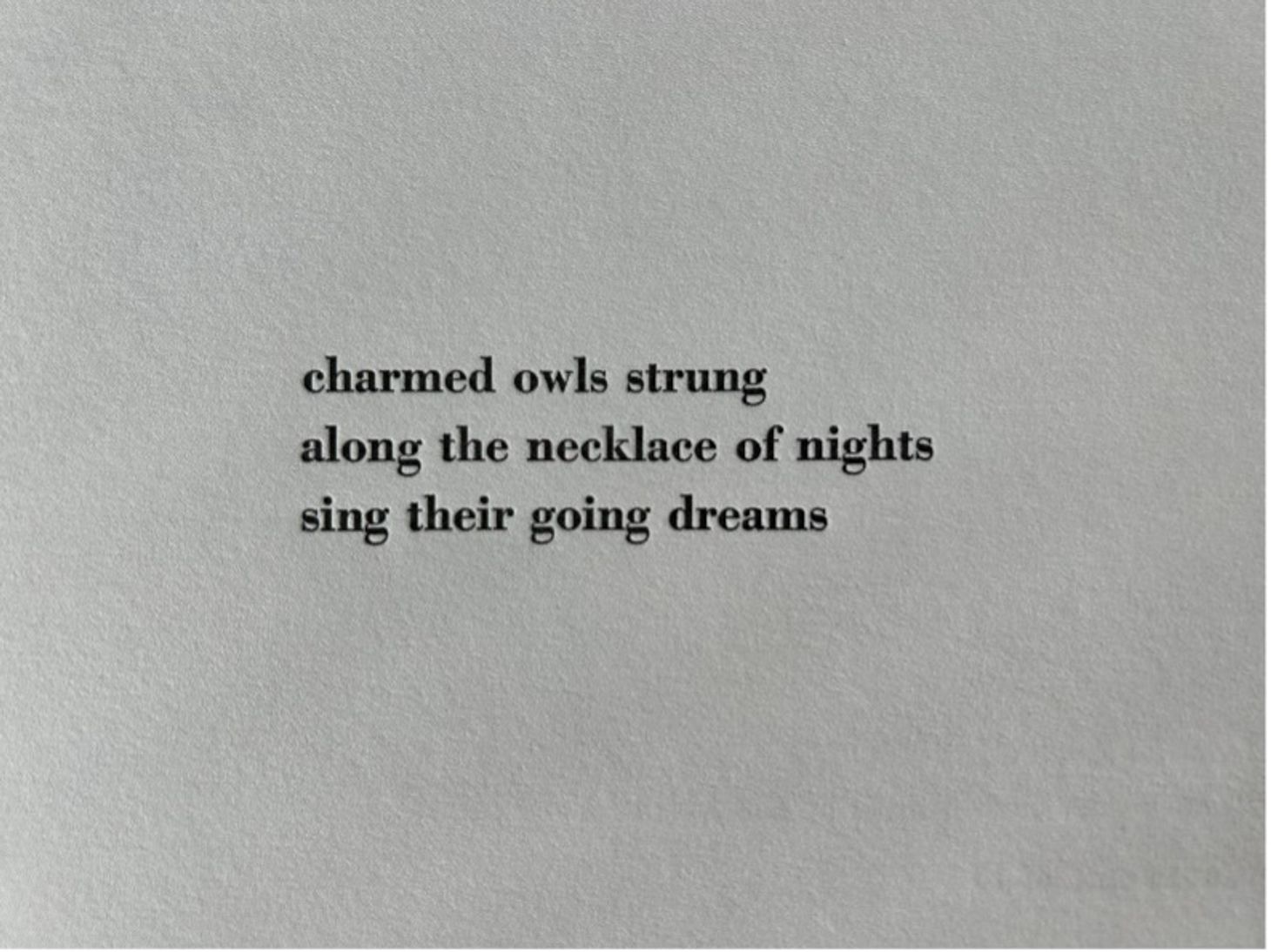
Then, it was time to gather my community. Finding nineteen readers took longer than expected. I started to have doubts. I had asked people to pay for their cards to cover my costs, including paying Jes, but I worried—was this asking too much? Was I burdening people with my art?
Around this time, I fell on the sidewalk while walking with my toddler. In the third trimester of my pregnancy, my center of gravity had shifted dramatically forward, but my brain hadn’t caught up. Upon standing, I saw the grime the sidewalk had imprinted on my white shirt, a gray circle about the size of my hand over my pregnant belly. I drove us to the hospital, turned down the offer of a wheelchair, and walked the labyrinthian halls holding my daughter’s soft hand, to a windowless room for monitoring. The baby was okay. We went home. During my daughter’s nap, I scrubbed the stain from my shirt.
~
After several weeks of reaching out to family and friends, I found my readers. I randomly ordered their names in a spreadsheet and assigned everyone a stanza. I then wrote on the back of each letterpress card the number of the stanza it featured, as well as the contact information of the people who received the stanzas immediately before and after. I distributed the cards with instructions: the recipients would need to work together to assemble the whole poem.
Though dreaming up this community of readers and printing the cards had all felt quite romantic and exciting, the spreadsheeting and emailing and addressing of the envelopes reminded me of the administrative assistant jobs I had worked for my first few years out of college. It wasn’t drudgery, exactly, but the line between what was done and what was yet to be done was much cleaner than I was used to in my writing practice. To let it go, all I had to do was hand the kraft paper envelopes to the kind folks at the post office.
At this same time, my sleep was also deteriorating. At first, I would wake around midnight, go back to sleep, and then wake again around five. But each night I began to wake gradually earlier and earlier after my midnight stirring—four in the morning, then three. Each afternoon, exhausted, I lay on the sofa and breathed while my toddler brought me various objects: a wooden toy cookie, a board book about the seasons, an attachment for the vacuum.
Messages of confusion rolled in from my readers. Some of the confusion was intended on my end, because I’d left it up to them to figure out how to assemble the whole poem. Nevertheless, hearing their confusion had me doubting the project, again. I feared that my poem would not be assembled after all, and the project would be a failure.
And then, a couple of months after my final trip to the post office, under a foggy spring rainbow, I gave birth to my second child. When summer had passed into autumn, and my son was nearly five-months old, I reached back out to my community of readers, this time with the poem in full and some questions.
It seemed most of them had connected with at least one or two others, sharing not only their stanzas but photos of their pets and how they knew me. Several said the stanza they had been assigned remained their favorite, even after seeing the whole poem—which I love. And despite at first feeling sad that the poem had not been fully assembled, I ended up seeing this incomplete assembly as part of the process, of the performance. Once I let the work out into the world, those stanzas no longer belonged to me but to others—in their mailboxes, on their walls, in their desk drawers. Regardless of my expectations, the plan I’d set out with was to nurture community, and these micro-communities of three or four people were more than sufficient. They were important and really beautiful.
One dog, whose owner shared her photo with another participant, has since passed away. The baby is now crawling and likes to eat cold spears of cucumber.
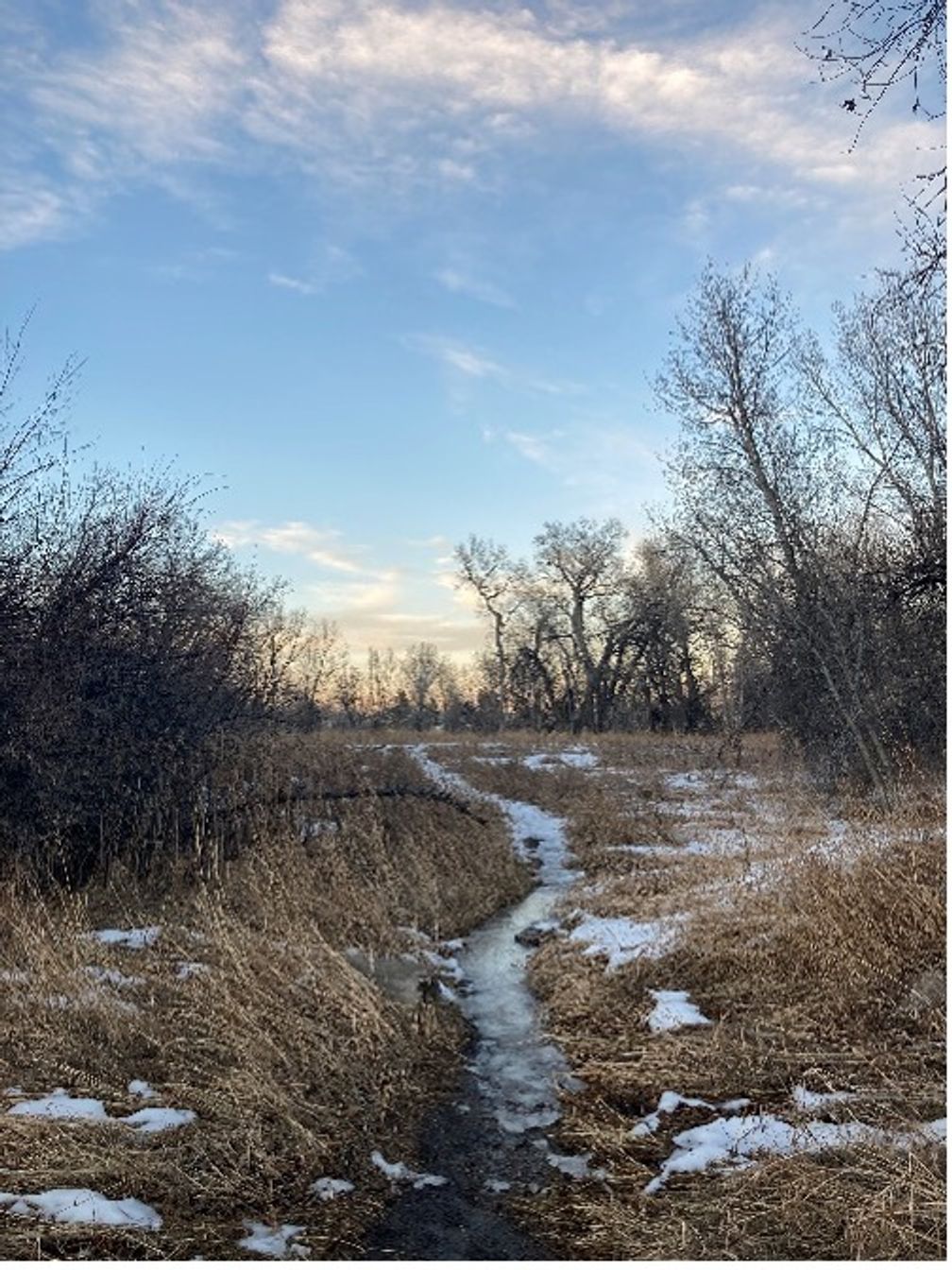
The experience of scattering the poem reminds me of walking my dog in the field by the house we once lived in. The field was ragged with golden stalks of dead weeds and dormant grasses. Patches of dirt peered up from beneath hard snow. The sky was silver, sometimes coral, sometimes a wan, washed blue. Then it was dark as ink, pierced with cold stars. My dog’s sleek, brindled body, the color of a weathered wooden fence, slithered cleanly through the field. “The every dailiness of want,” I wrote in the poem I then scattered, “is a dream that arrives and arrives / breaking as waves of dawn // against your outstretched hands / whose lines are footprints through the snow.”
The poem circles around itself, as would any whose stanzas can stand alone. My dog and I circled around that field, day in and day out, until my daughter was born and we left that neighborhood for another.
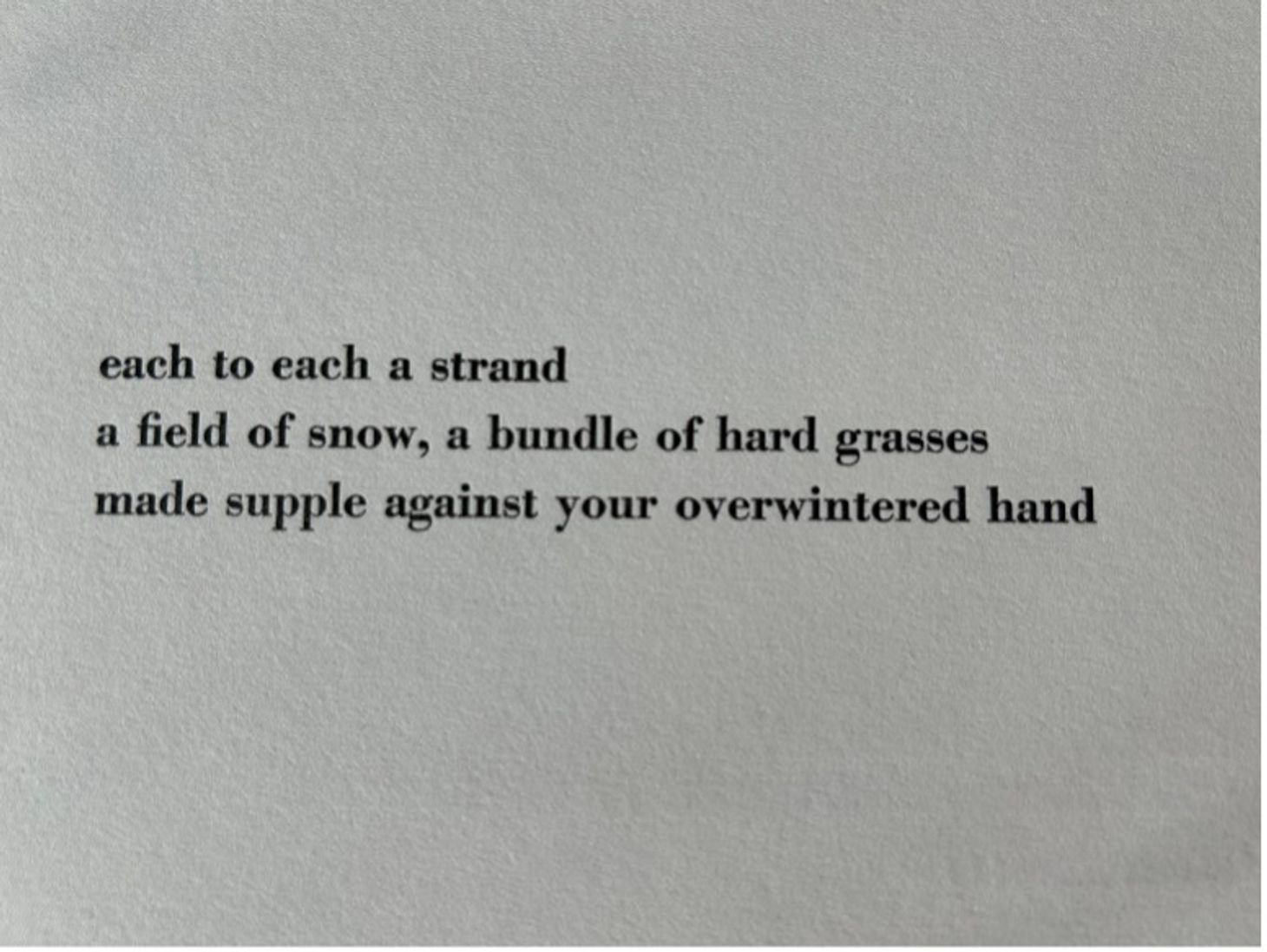
Later, the poem asks, “what canyon are you crawling out from / to chase the going morning?”
The canyon is a point of origin. Maybe it is a mother, or maybe it is a community, or maybe it is both. As the poem circles and continues, unbroken by punctuation, it traces the movement of the hours. Left in many readers’ hands, it invites you to make your own tracings, too.

Katherine Indermaur
Katherine Indermaur is the author of I|I (Seneca Review Books, 2022), winner of the Deborah Tall Lyric Essay Book Prize and the Colorado Book Award, and two chapbooks. Her writing has appeared in Ecotone, Electric Literature, Gigantic Sequins, AGNI, The Missouri Review, and elsewhere. She has also won the Black Warrior Review Poetry Contest and the Academy of American Poets Prize. An editor of Sugar House Review, she lives in Fort Collins, Colorado. (updated 10/2025)